
How Much House Can I Afford? | Home Affordability Calculator
Welcome to our Home Affordability Calculator, your trusted resource for determining how much house you can afford. Our user-friendly tool is designed to help home buyers, first-time home buyers, and homeowners make informed decisions by evaluating key factors like income, monthly debts, down payment, interest rates, and more. Gain a comprehensive understanding of your potential mortgage payments and housing costs, and explore detailed affordability insights to confidently navigate the real estate market. Start your journey towards owning your dream home today with clarity and precision.
Your Inputs
Your Affordability Results
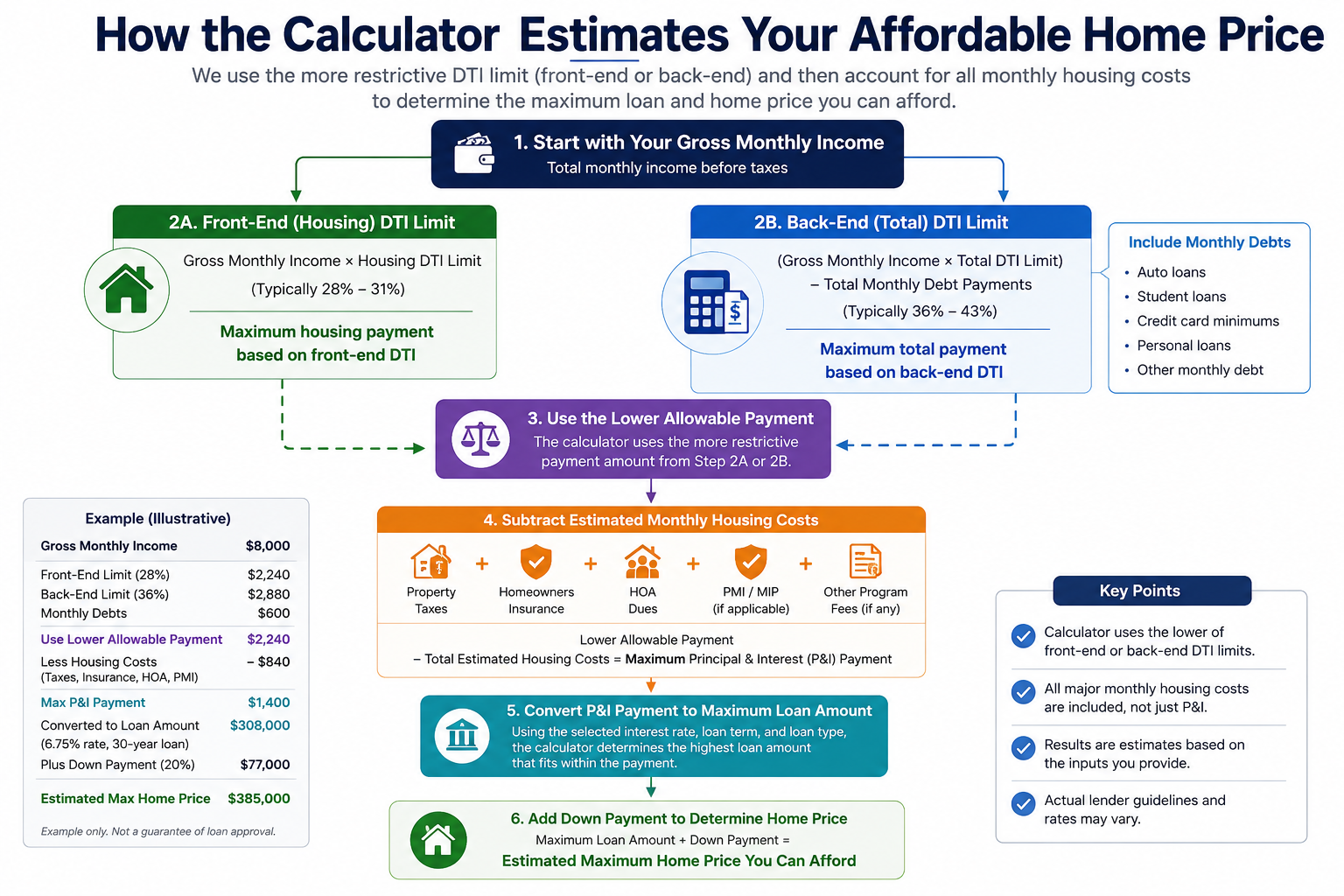
The front-end DTI limit is currently the more restrictive rule.
Results are estimates for planning purposes. Actual rates, underwriting standards, fees, and approved amounts vary by lender and loan program.
See What You May Qualify For
You have an estimated home-buying budget. Continue to explore mortgage options based on your affordability scenario.
Your calculator result is an estimate and is not a loan approval. Qualification depends on lender requirements, income, debts, credit, down payment, and other borrower factors.
Monthly Payment Breakdown
See how your estimated all-in payment is divided among principal, interest, taxes, insurance, HOA dues, and mortgage insurance.
Buying Power at Different Interest Rates
Compare the estimated maximum home price if mortgage rates move one percentage point in either direction.
DTI Capacity
How to Interpret Your Affordability Estimate
Based on the values entered, the calculator estimates that a home price near $412,036 would produce an all-in housing payment of approximately $2,800.00 per month.
Your estimated loan amount is $329,629with a down payment of $82,407. The starting loan-to-value ratio is approximately 80.0%.
The calculation uses the lower housing allowance produced by your front-end and back-end DTI limits. Reducing monthly debts, increasing the down payment, lowering the interest rate, or choosing a less expensive property can create more budget room.
See What Homes You Can Afford and Your Loan Options
Now that you’ve estimated your home buying budget, take the next step. See what loan options are available within your price range and explore personalized rates from trusted lenders - all based on your affordability.
Brief Overview
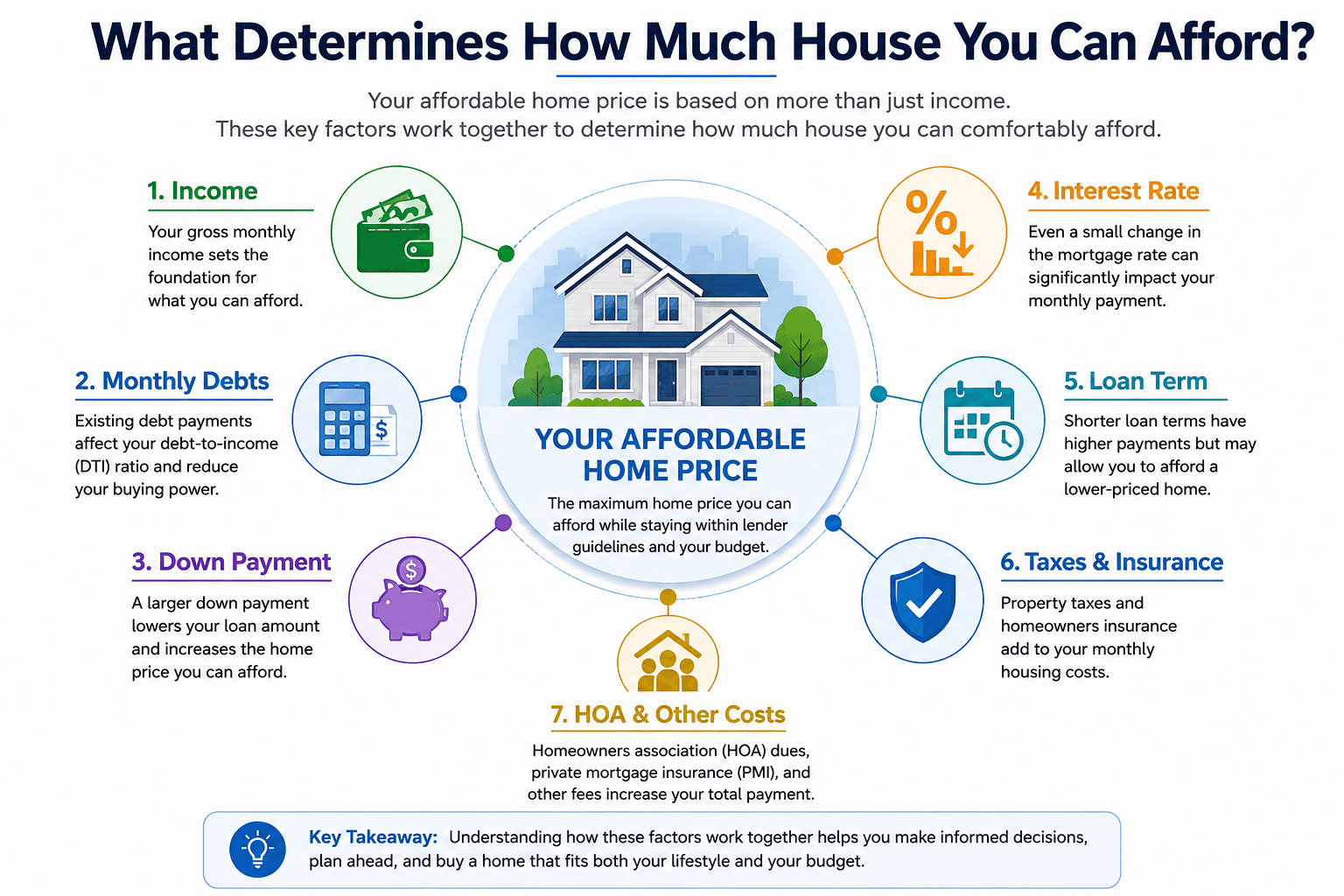
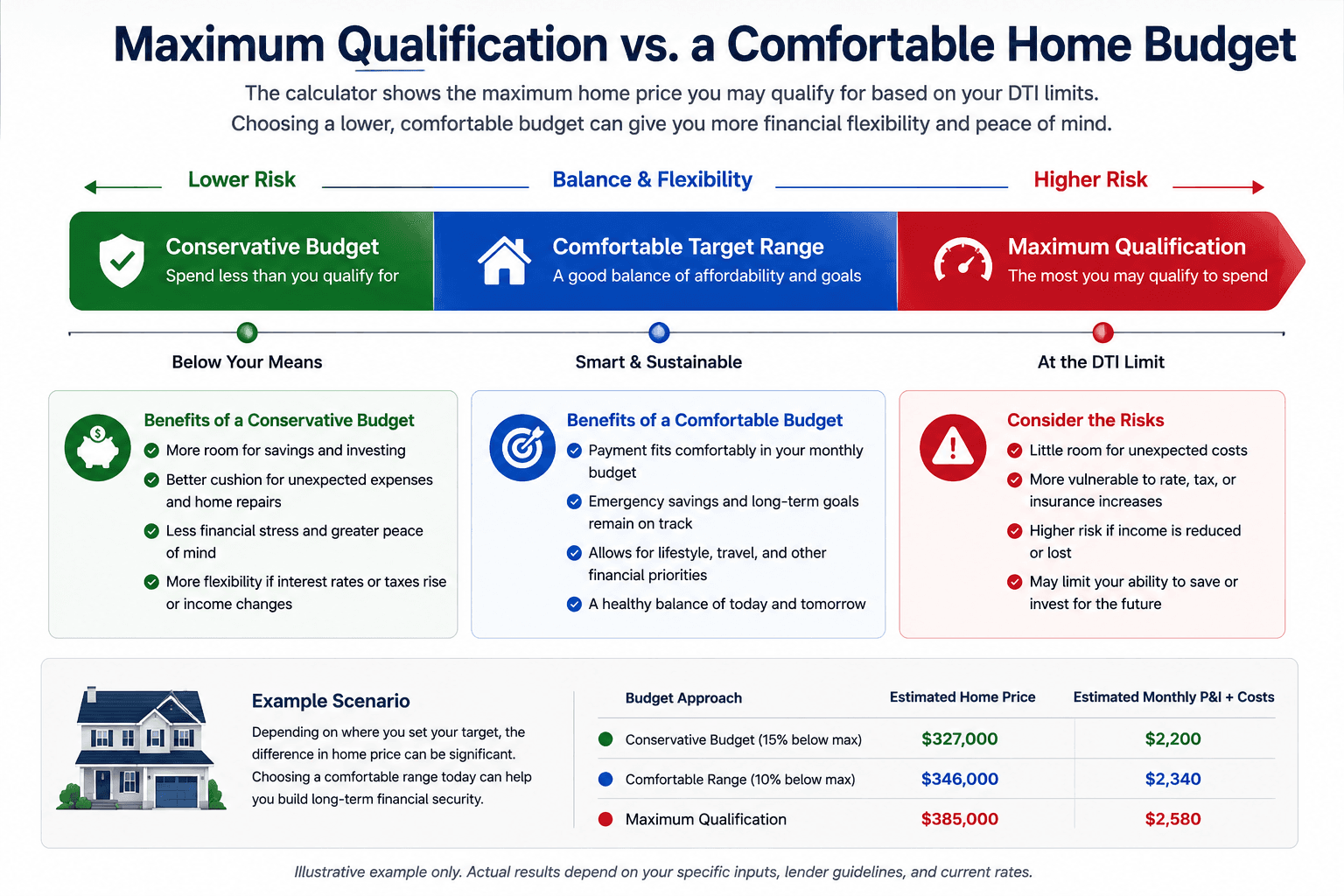
Understanding home affordability is crucial for informed home-buying decisions, and our free Home Affordability Calculator is a valuable tool in this journey. It evaluates key financial factors such as income, monthly debts, down payment, interest rates, and more to determine the maximum home price you can comfortably afford. By providing insights into potential mortgage payments and housing costs, this tool empowers users to make sound financial choices. Additionally, it highlights the impact of debt-to-income ratios and other expenses like property taxes and insurance, ensuring a confident and secure approach to home ownership.
Key Highlights
- Use the Home Affordability Calculator to estimate how much house you can afford based on income, debts, and savings.
- Factors like interest rates and loan terms significantly impact home affordability and your mortgage payments.
- The debt-to-income (DTI) ratio is crucial; lower DTI enhances affordability by improving loan approval chances.
- Strategies for lowering monthly debts, like prioritizing high-interest loans, can improve your home affordability.
- Utilize the Home Affordability Calculator to understand financial impacts, making informed real estate decisions easier.
Understanding Home Affordability: What It Means for You
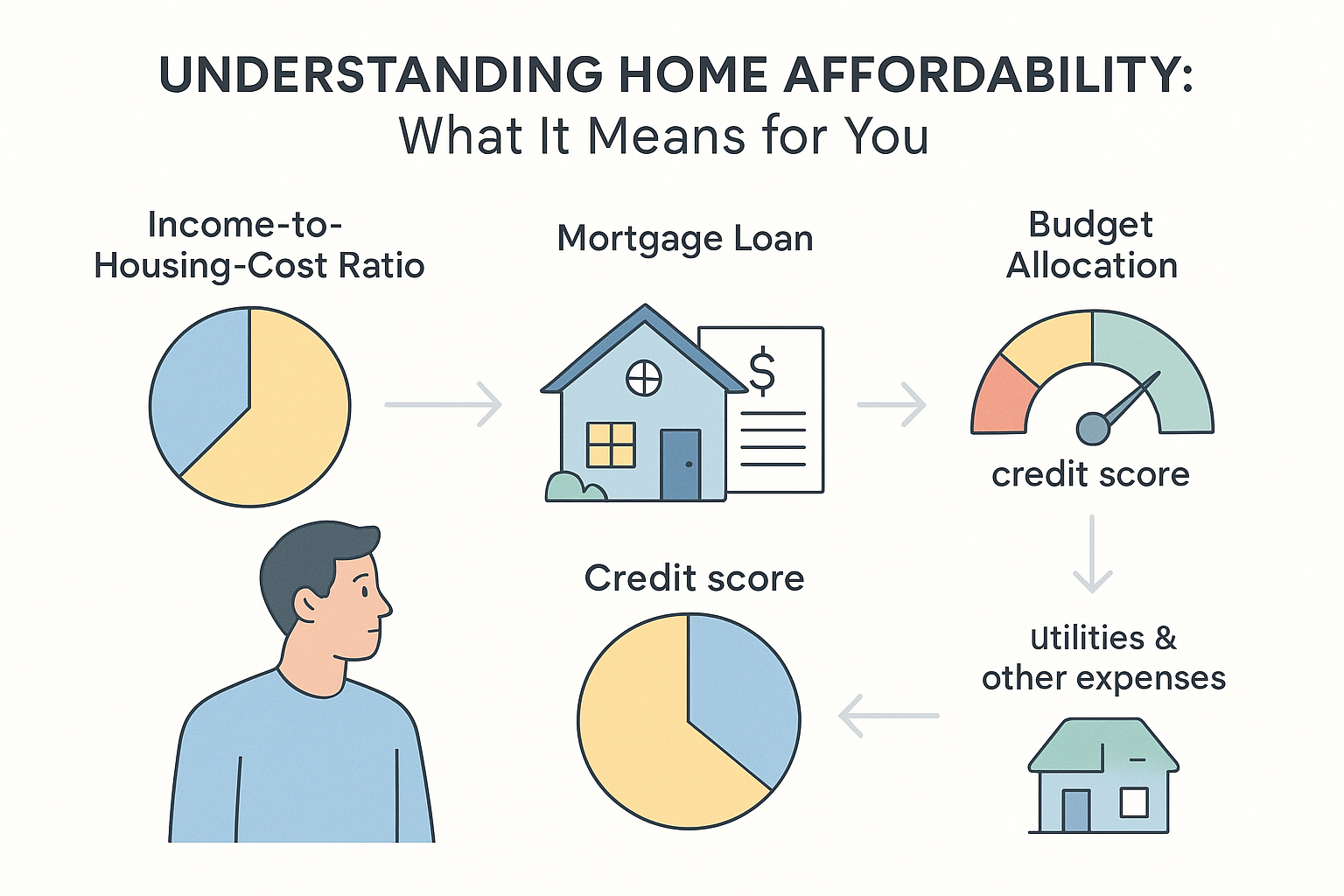
Home affordability plays a critical role in determining how much home you can afford. It takes into account your income, debts, and potential housing costs to help you make financially sound decisions. The location of your future home can significantly influence home affordability, as well as current mortgage rates. Understanding these factors will ensure you're not overextending yourself financially. Calculating home affordability involves considering your financial situation, such as your savings, debt obligations, and the desired down payment. Options like FHA loans and conventional loans also play a part in this process, each offering different benefits depending on your credit and down payment size.
Using a home affordability calculator provides a comprehensive view of how these elements come together. This tool incorporates variables like interest rates, loan terms, taxes, insurance, and HOA fees to pinpoint what home price fits your financial profile. When you use a mortgage calculator, it's essential to consider the impact of your current debts on your mortgage payment and overall affordability. Effectively manage your home equity and financial resources by knowing your limits. Whether you're a first-time homebuyer or a seasoned investor, understanding home affordability helps you make informed decisions. By determining a realistic home price, you'll ensure your financial future is stable. Combining home affordability insights with professional guidance can maximize your investment opportunities and make your home-buying journey smoother.
The Role of Income and Debts in Home Affordability
Understanding the role of income and debts is crucial when determining your home affordability. Your monthly income is a key factor in establishing how much house you can afford. Lenders consider your total monthly income to ascertain if your income can comfortably cover your mortgage payment along with other monthly debts. Accurately estimating your existing financial commitments helps calculate the debt-to-income ratio (DTI), which is pivotal in loan approval. The DTI ratio measures the percentage of your total monthly debts against your monthly income. A lower DTI indicates a healthier financial standing and enhances home affordability. It’s essential to account for all your monthly debts, including credit card payments, auto loans, and other financial obligations. Monthly debts influence your capacity to maintain regular mortgage payments without financial strain. When computing potential loan amounts, the calculated DTI offers insight into possible interest rates you might qualify for. It's important to remember that insurance costs and the loan term also affect your overall financial picture. Opting for a realistic loan term can lead to manageable monthly payments. Evaluating both income and debts provides a comprehensive view of your financial capabilities, ensuring that you don’t overextend your financial limits. By using our Home Affordability Calculator, you can effortlessly estimate your home affordability with insights into your required loan amount, loan term, and overall monthly payment expectations, enabling informed decisions in your home buying journey.
How Home Prices and Features Affect Affordability
Understanding how home prices and features affect affordability is crucial when determining your overall housing costs. The price of a home is not just about the location or size; it's also about the features and amenities that come with it. For example, desirable features like a modern kitchen, extra bedrooms, and energy-efficient systems can boost the home price. Before applying for mortgages or FHA loans, assess how these features align with your savings goals and long-term financial plans. A higher home price translates to a larger loan amount, affecting your monthly mortgage payments, insurance premiums, and interest rates. Whether you're looking at fixed-rate or adjustable-rate loans, each type of mortgage will impact how much equity you can build over time. Interest rates also play a pivotal role; a lower interest rate can make a higher home price more affordable. Additionally, don't overlook homeowners' association fees, property taxes, and home insurance costs. These monthly costs can quickly add up, affecting overall affordability. Our mortgage calculator will help you evaluate various scenarios, giving you a clear picture of what you can afford. It factors in your down payment, loan amount, and interest rates to determine your potential home equity over the years. Ultimately, home affordability will depend on a balance of your income, debts, and housing costs. By understanding how home prices and features impact affordability, you can make informed decisions, ensuring your home-buying journey is as smooth and rewarding as possible.
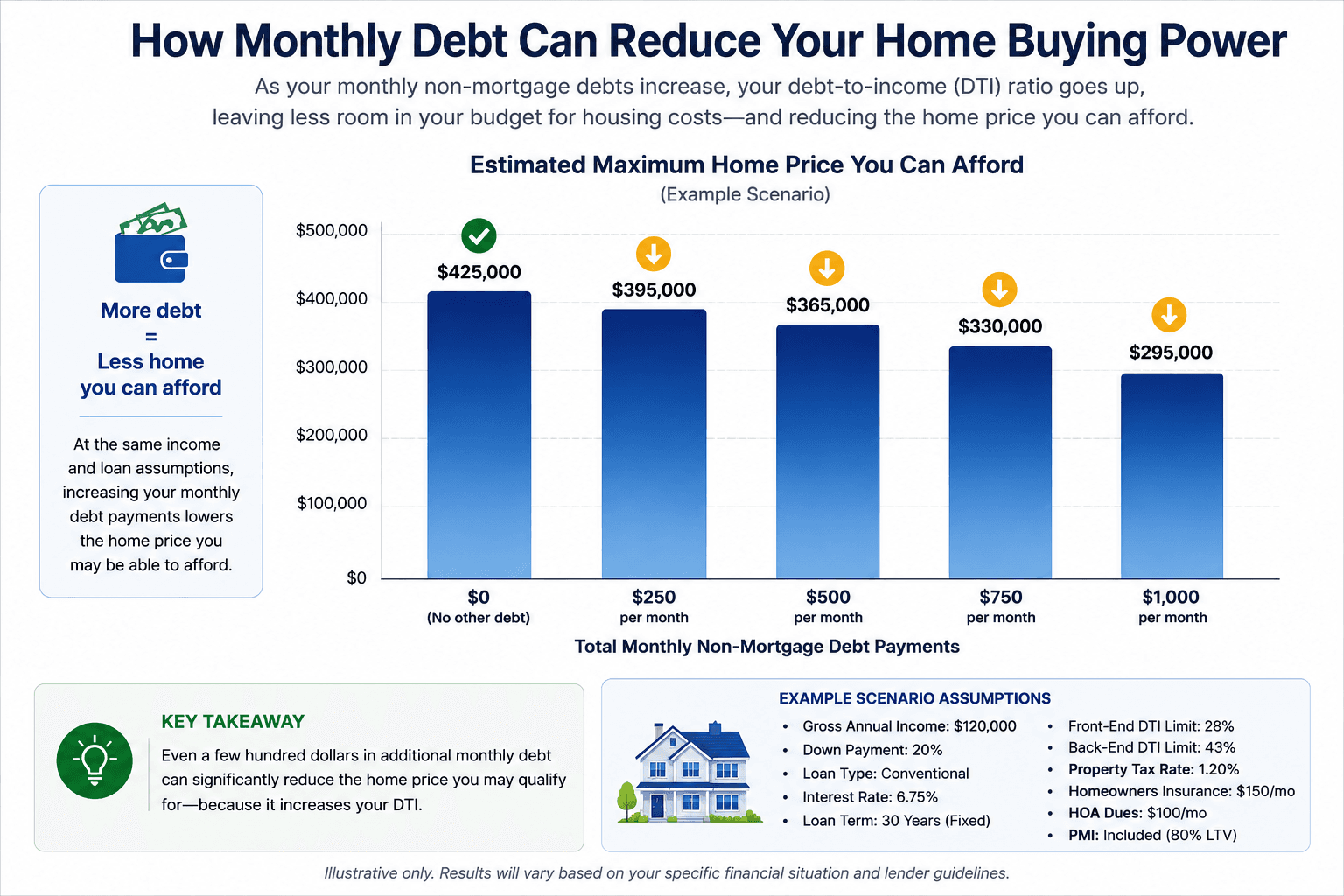
How Monthly Debts Influence Your Home Buying Power
Understanding how monthly debts impact your home buying power is crucial when navigating the mortgage landscape. By calculating your total monthly debts, you gain insight into your debt ratio, a key factor in determining home affordability. Your debt-to-income (DTI) ratio assesses your financial health, comparing monthly debts to your gross monthly income. Lenders use this ratio to evaluate loan applications, affecting the mortgage payment you qualify for. More debts mean a higher debt ratio, reducing your ability to secure the desired loan. Balancing debts is essential; keeping a lower DTI enhances home affordability and expands your borrowing capacity. Interest rates also play a role; lower rates mean lower monthly payments. Thus, managing loans wisely can increase your home buying power. An affordability calculator considers interests and monthly expenses, helping to ensure your home budget aligns with financial capabilities. You might ask, "How much house can I afford?" Well, assessing debts helps determine loan size and type, like FHA options catering to various borrowers. Merging a sound financial strategy with a comprehensive understanding of debts and income boosts your mortgage prospects. Improving credit scores improves interest prospects, increasing affordability potential. Payments become more manageable, thus impacting home affordability. Using tools like an affordability calculator is invaluable for real estate shoppers and mortgage seekers. They help determine feasible monthly payments and debt management strategies, empowering informed decisions. Explore "How Much House Can I Afford?" to understand your buying power better and navigate mortgage complexities confidently.
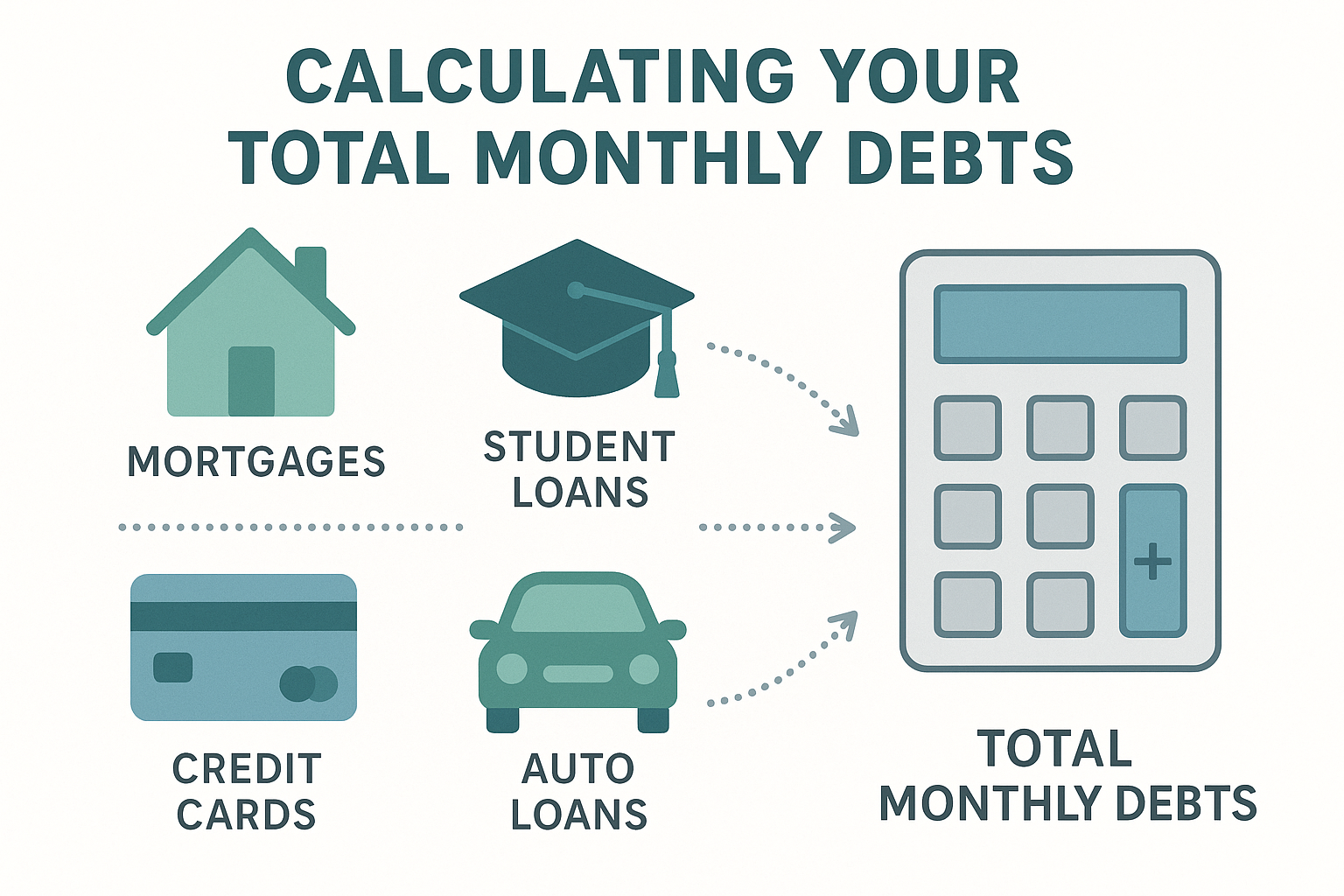
Calculating Your Total Monthly Debts
Understanding your total monthly debts is crucial in determining how much home you can afford. The calculation includes all monthly debts, from credit card payments, car loans, to student loans. By analyzing your debt ratio, or debt-to-income (DTI) ratio, you can evaluate your financial standing. Ideally, lenders prefer a DTI ratio of 43% or lower. To determine your DTI, calculate your total monthly debts and divide by your gross monthly income. This calculation helps you understand your financial health and adjust your affordability expectations. By including housing costs, insurance, and loan payments, you can better forecast your potential home price. The affordability of a home isn't just about the house price itself, but how the mortgage, property taxes, and insurance fit into your monthly debts. For those considering FHA loans, understanding your total monthly debts along with savings and monthly income is vital. FHA loans can offer more flexibility in mortgage approval, though it’s important to know how all these elements interplay. Remember, your loan and total loan amount must align with your financial capabilities. Accurate debt calculations ensure you won’t stretch your budget too thin. Understanding this supports more informed decisions regarding payment options and loan terms. In essence, accounting for your total monthly debts provides clarity on your true housing affordability. As you continue your home buying journey, use these insights to focus on realistic home prices that match your financial profile.
Strategies to Manage and Lower Monthly Debts for Better Affordability
Managing and reducing your monthly debts can greatly enhance your home affordability. One effective strategy is to systematically lower monthly debts by focusing on high-interest loans. Redirect your savings from reduced expenses into paying off these debts, gradually reducing your financial obligations. It's crucial to create a budget tailored to your income that prioritizes essential payments while cutting out unnecessary expenses. Over time, this will improve your debt ratio and increase your affordability.
Consider consolidating multiple debts into a single loan with a lower interest rate. This strategy can simplify your payments and potentially decrease your total financial burden. Additionally, regularly reviewing your insurance and home price commitments can reveal opportunities to save or renegotiate terms, maintaining a better balance in your monthly expenses.
If you're planning significant purchases or considering new loans, carefully evaluate how they'll affect your overall debt ratio and monthly payment plans. Keeping your debt-to-income (DTI) ratio low is key to favorable mortgage terms. So, consistently monitor your credit to ensure you're in a strong position when you're ready to buy a home. Incorporating these financial strategies will not only lower monthly debts but also align your financial profile with greater home affordability.
In conclusion, by effectively managing debts and developing a strategic approach to your finances, you'll establish a stable foundation to confidently approach mortgage considerations and maximize your affordability, ensuring that your dream home is within reach without jeopardizing your financial health.
Continuing with our strategies to effectively manage and lower your monthly debts, consider incorporating these additional actionable steps into your financial plan:
- Create a detailed budget to track income and expenditures, ensuring you allocate funds towards debt repayment consistently.
- Prioritize paying off high-interest debts first to reduce the overall interest burden and expedite your debt-free journey.
- Consider debt consolidation options to simplify payments, potentially securing a lower interest rate and reducing monthly obligations.
- Engage in negotiations with creditors to lower interest rates or extend repayment terms, easing your immediate financial pressure.
- Increase your income through side hustles or freelance work, directing any additional earnings towards debt reduction efforts.
- Regularly review and adjust your financial strategy to accommodate changes in circumstances or to accelerate progress towards your goals.
- Establish an emergency fund to avoid relying on credit during unforeseen expenses, helping to keep your debt in check.
By implementing these strategies, you can make significant strides in reducing your monthly debts, paving the way toward financial freedom.
Using an Affordability Calculator to Estimate House Costs
Navigating the journey to homeownership can be daunting, but with our affordability calculator, estimating house costs becomes more manageable. This tool helps you determine a realistic home price based on various financial factors. To begin, input your income, monthly debts, and savings to understand your financial standing. The calculator integrates key variables such as the loan amount, interest rate, and loan term to offer a comprehensive analysis of your mortgage payments. By doing so, it aids in calculating your total housing costs effectively.
Furthermore, the affordability calculator takes into account factors like FHA loans, which might be suitable for some borrowers due to their flexibility. It considers property taxes, insurance, and potential HOA fees to ensure you're prepared for all eventualities related to home affordability. By calculating how much house you can afford, this tool offers insights to align your dream home aspirations with your financial reality. Estimates are derived by evaluating your debt-to-income ratio, ensuring an accurate reflection of financial health.
Understanding the breakdown of the estimated mortgage payment is crucial. This calculator provides clarity on the financial implications of your choices, whether you're a first-time buyer or looking to refinance. The interest rate and loan term can significantly influence the cost of your home. Therefore, utilizing this resource allows for informed decision-making, ultimately easing the path toward homeownership. By assessing these elements, our home affordability calculator empowers you with the knowledge needed to make financially sound housing decisions.
| Key Input Factors | Financial Implications | Strategic Insights |
|---|---|---|
| Income | Impact on Loan Terms | Choose Appropriate Loan Term |
| Monthly Debts | Effect on Monthly Payments | Monitor Interest Rate Changes |
| Savings | Down Payment Influence | Plan for Future Expenses |
| Credit Score | Affects Interest Rates | Improve Credit Score |
Short Description: This table highlights how key input factors like income, monthly debts, and savings interact with financial implications such as loan terms and monthly payments. Strategic insights provide actionable advice, emphasizing a considered approach when using affordability calculators to align home buying plans with financial realities.
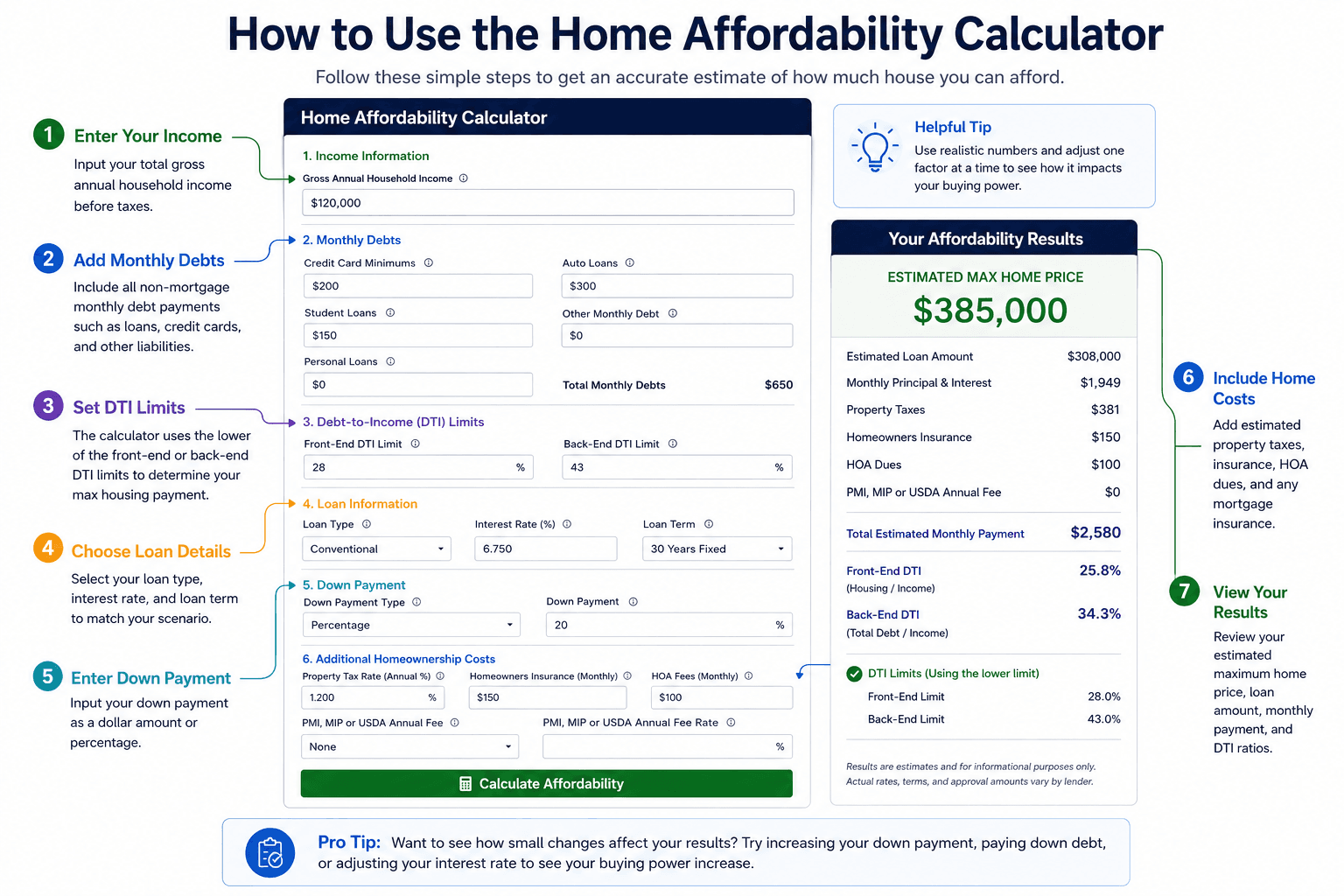
Step-by-Step Guide to Using the Calculator Effectively
Using the Home Affordability Calculator to determine home affordability is simple, but knowing how to navigate it effectively can maximize its benefits. Start by entering your annual income and monthly debts, which are crucial for calculating your debt ratio. A lower debt ratio can significantly enhance home affordability. Next, input your desired home price or the estimated home price you qualify for based on your income. Consider any savings you have for a down payment, as this can affect your loan terms and the mortgage amount you need, thus influencing housing costs and monthly payments. Adjust the interest rate field to reflect current mortgage rates, as even slight changes in interest can notably affect affordability. Choose a loan term that suits your financial goals; longer terms may result in reduced monthly payments but higher total costs, while shorter terms can save on interest over time. Don’t forget to account for property taxes, insurance, and any HOA fees, as these are integral components of your monthly mortgage and housing costs. These steps provide a comprehensive guide on using the affordability calculator effectively, helping you make informed decisions on potential loans. Whether you’re a first-time homebuyer or planning to refinance, understanding these steps can enable more strategic and effective decision-making in your home financing journey, helping you achieve the financial balance you seek.
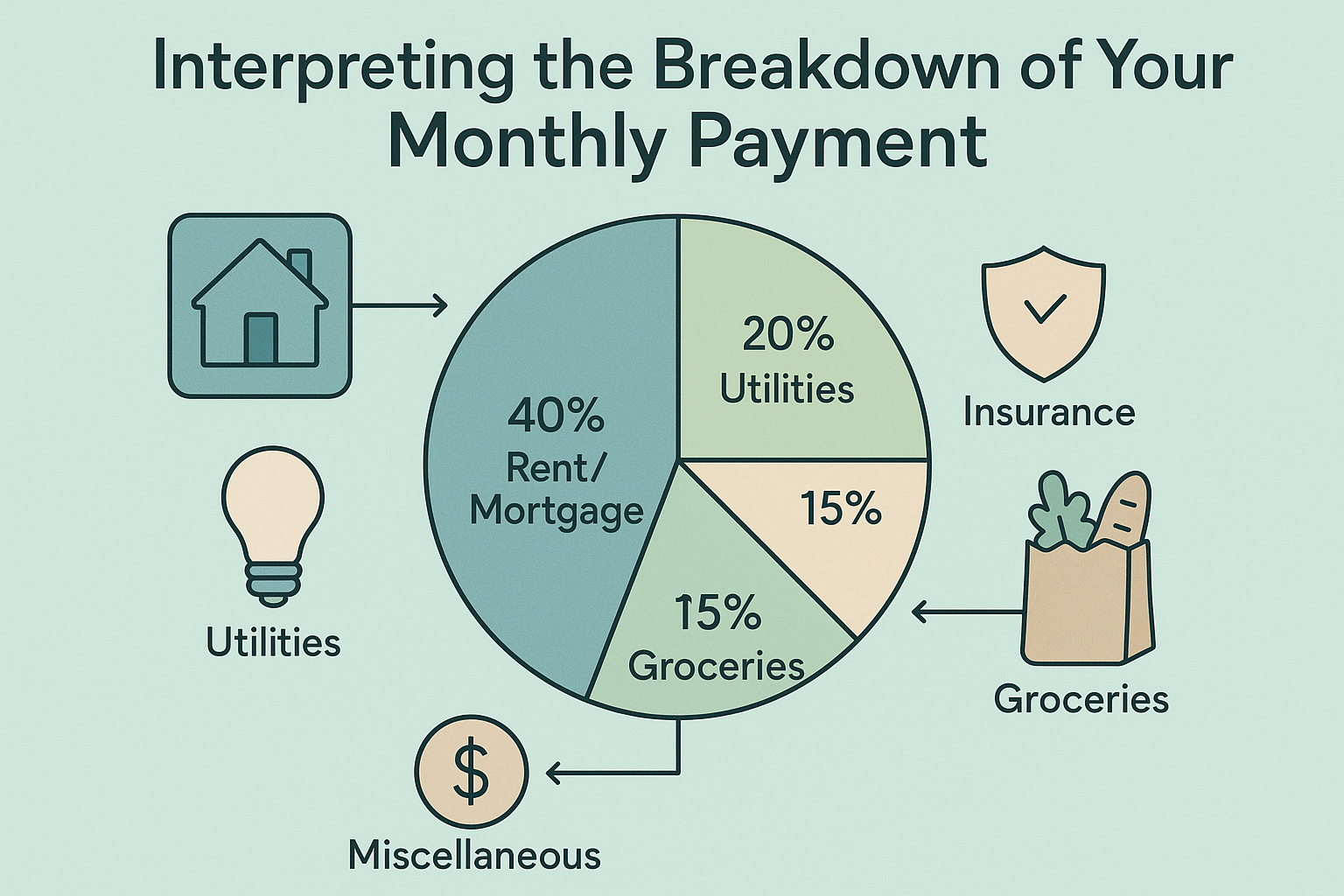
Interpreting the Breakdown of Your Monthly Payment
Interpreting the breakdown of your monthly payment is crucial for identifying how much of your finances are allocated towards each aspect of your mortgage. By using our affordability calculator, you can calculate the precise monthly payment you'll need to cover your mortgage. This includes principal, interest, and elements like insurance and property taxes. You can explore how each factor, such as mortgage rates and home price, influences your overall financial output. The breakdown is essential because your mortgage payment consists of more than just the loan amount and interest. It comprises taxes, insurance, and potentially HOA fees. By looking at this, you can gauge how much of your monthly income you'll need to commit. Whether you're a first-time homebuyer or planning to refinance, knowing exactly what you're paying for can lead to smarter financial decisions, helping you to maintain healthy savings while managing debts. Our calculator helps you see this breakdown clearly, emphasizing how certain variables impact the mortgage payment. Understanding these components enables you to strategize better, knowing how much house you can afford without financial strain. A well-interpreted payment breakdown, reflecting credit and current mortgage rates, ensures you're making informed decisions for loans suited to your budget. This financial articulation is pivotal with every home affordability journey, revealing where each dollar goes and how it affects overall affordability. Stay informed and empowered by comprehensively examining each part of your payment with our calculator.
Factors That Determine How Much House You Can Afford
Understanding the factors that determine how much house you can afford is crucial for making informed financial decisions. Your income is a primary consideration, as it directly affects your ability to manage monthly payments and overall housing costs. Alongside income, your debt ratio, known as the debt-to-income (DTI) ratio, plays a significant role. A lower DTI indicates better financial health and can enhance your home affordability. Current mortgage rates also impact how much house you can afford, with lower interest rates reducing the cost of borrowing and increasing your purchasing power.
Moreover, the loan term you choose affects your monthly payments. Longer terms may lower payments but increase the total interest paid over time. In contrast, a shorter loan term might increase monthly payments but decreases the overall interest. It's essential to factor in property taxes, insurance, and any HOA fees, as these are integral components of the total cost. A reliable mortgage calculator can help you assess these variables, providing a comprehensive view of your potential home price.
Don’t overlook the importance of savings, such as for a down payment, which can lower your required loan amount and potentially your interest rate. Additionally, your credit score influences mortgages and interest rates, impacting affordability. By understanding these factors, you can better determine how much house you can comfortably afford. Use this knowledge to make strategic decisions regarding payment structures and mortgage options, ensuring your housing costs align with your financial goals.
The Impact of Mortgage Rates on Home Affordability
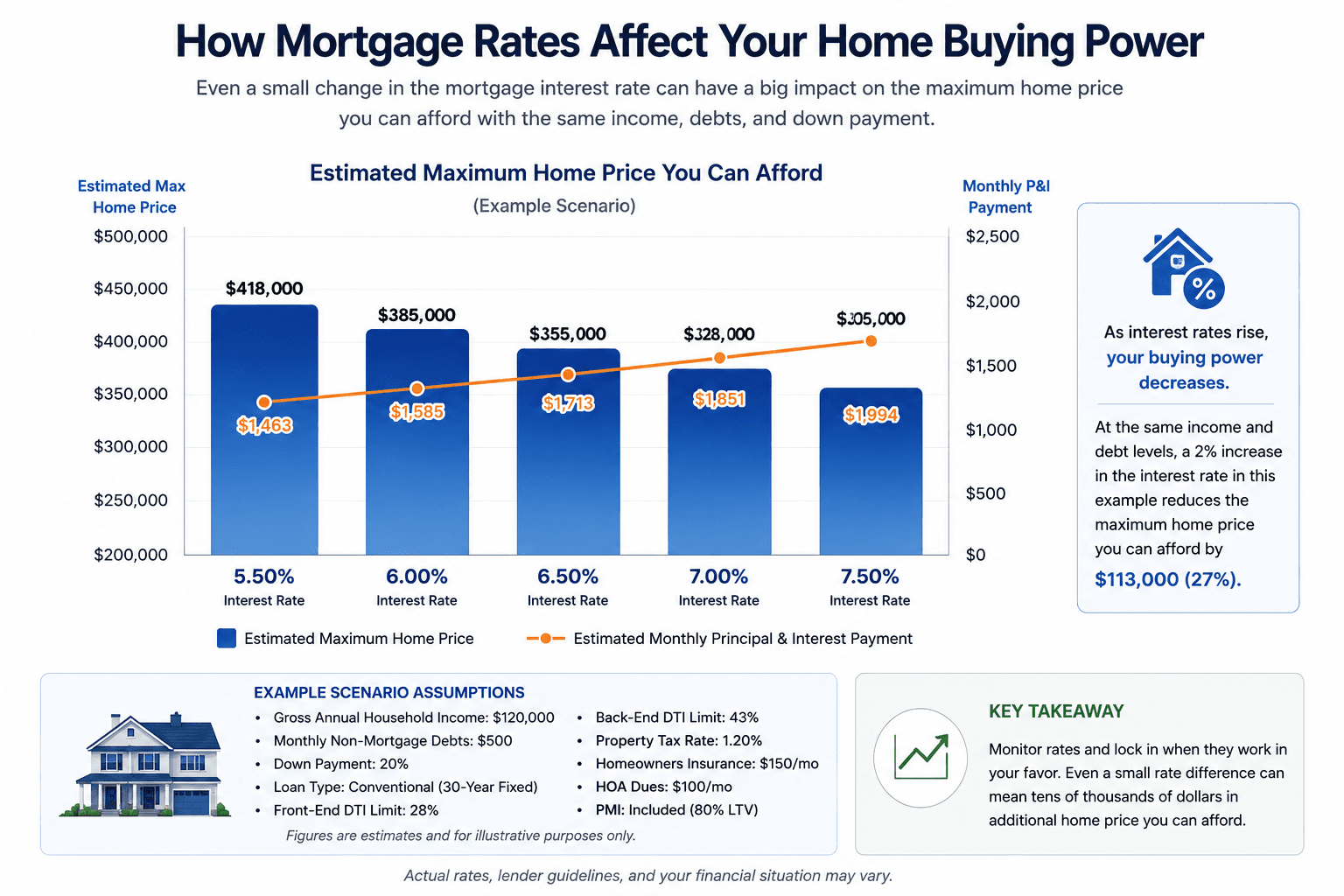
Understanding the impact of mortgage rates on home affordability is crucial for anyone exploring the housing market. The mortgage interest rate directly influences your monthly mortgage payments and your financial capacity to manage a loan. When using an affordability calculator, the interest rate you input can significantly affect your potential loan amount and home price. Lower rates mean reduced monthly payments, allowing you to afford a higher home price. Conversely, higher mortgage rates can limit your home affordability, exerting strain on your financial resources. Determining the best rate for you should account for your credit score, as this will influence the rates lenders offer. Fixed-rate mortgages provide predictability, helping maintain stable payments throughout the loan term, crucial for long-term financial planning. Whether you're considering FHA loans or conventional ones, understanding how rate fluctuations impact affordability helps make informed decisions. Including property taxes and insurance in your calculations is essential as these affect total payments. If payments are too high, consider adjusting your desired loan amount or exploring loans with different terms. Home Affordability Calculator allows you to explore various scenarios. Don't forget the role of your debt ratio in determining how much house you can afford. Balancing savings, credit, and the right rate can maximize home affordability. Ultimately, a deeper understanding of the influence of mortgage rates on your financial situation empowers smarter home-buying decisions.
Understanding Loan Term Options and Their Implications
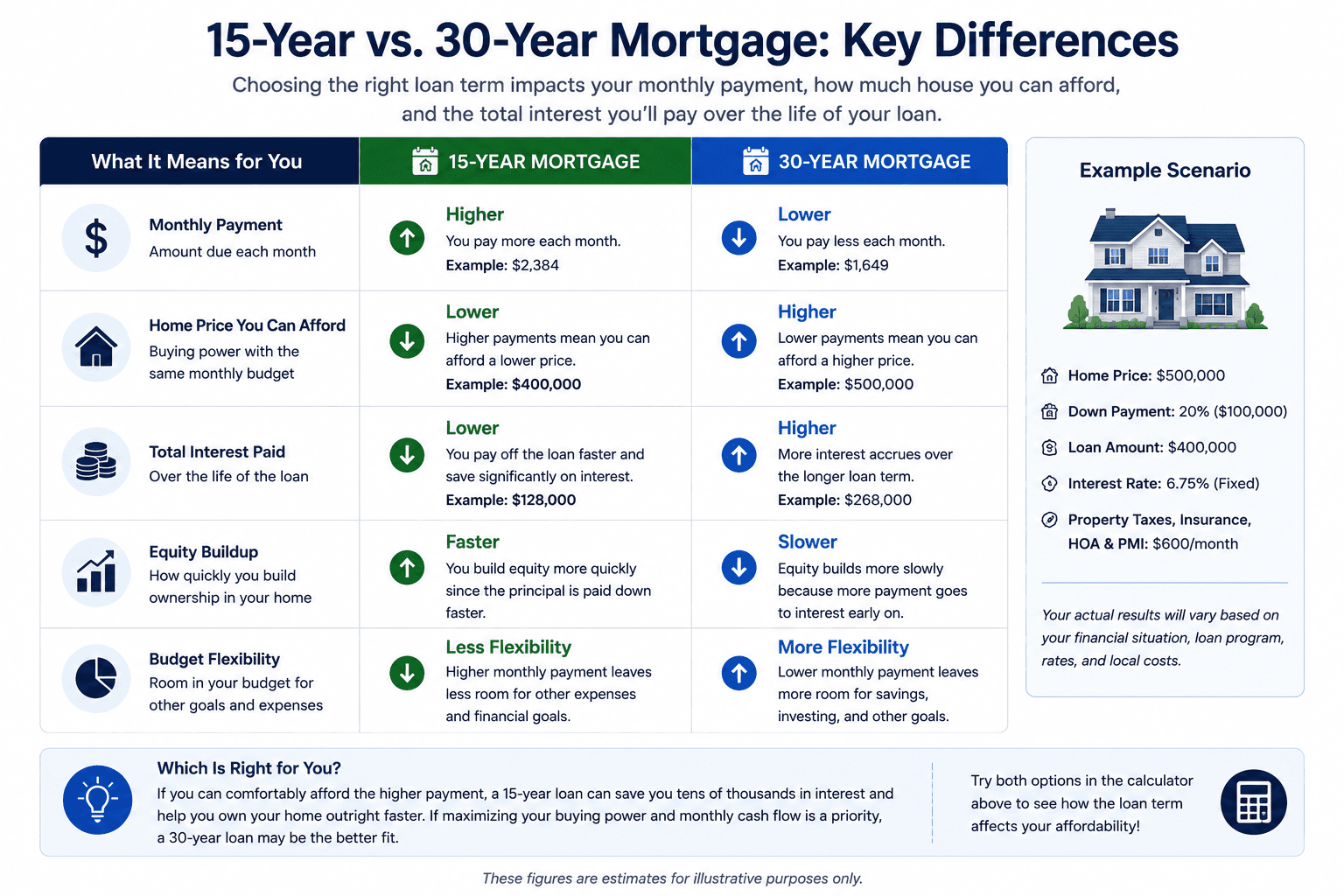
Understanding loan term options is crucial when using a mortgage calculator to estimate home affordability. Each loan term option affects not only your monthly payments but also the total interest paid over the loan's life. Typically, shorter loan terms, like a 15-year loan, carry higher payments but lower interest costs, compared to a 30-year loan term which offers lower payments but higher interest costs. When considering affordability, it's essential to factor in how these terms impact your monthly financial obligations and overall debt ratio (DTI). By selecting appropriate loan term options, you can better manage your mortgage payments in line with your income and other debts. Opting for fixed mortgage rates during a specific loan term might increase the predictability of payments, alleviating risks associated with fluctuating interest rates. This choice is important when determining the maximum home price you can afford. Moreover, your credit score also influences the mortgage rates you'll receive, adding another layer to understanding implications of your loan choices. Additionally, don't overlook the role of property taxes, insurance, and potentially HOA fees, as they significantly affect the total loan amount and monthly affordability. By understanding these factors, you can make informed decisions about home prices within your financial means. An effective analysis of loan term options aids in achieving optimal savings. Using our affordability calculator, you'll quickly grasp the impact on your financial landscape, ensuring your home buying event aligns with your long-term financial goals.
Understanding how much house you can afford is essential for making informed home-buying decisions. With our free Home Affordability Calculator, powered by MortgagePaymentCalculator.io, you can explore accurate estimates based on your income, debts, and other financial factors. This tool helps you plan smarter, ensuring you never overextend your budget. By considering critical components like taxes, insurance, and HOA fees, you can navigate the housing market with confidence. Use our calculator to align your home search with your financial reality and pave the way to a secure and manageable home ownership experience.
Frequently asked questions
What factors does the MortgagePaymentCalculator consider for home affordability?
We consider several factors when assessing home affordability, including your income, monthly debts, down payment, interest rates, loan terms, and additional housing costs such as property taxes and insurance.
How does the debt-to-income ratio affect my home-buying power?
Your debt-to-income (DTI) ratio is pivotal in determining home affordability. A lower DTI ratio improves your chances of loan approval and can enhance your ability to afford a higher-priced home by demonstrating a healthier financial standing.
What strategies can I use to improve my home affordability?
To improve home affordability, focus on lowering monthly debts, such as prioritizing the repayment of high-interest loans. Managing savings and budgeting effectively can also create more room for potential mortgage payments.
How do different loan types impact home affordability?
Loan types, such as FHA and conventional loans, influence home affordability based on credit requirements and down payment size. Each loan type offers specific benefits that can affect your monthly mortgage payment and interest rates.
Why are interest rates crucial in understanding home affordability?
Interest rates significantly impact home affordability by affecting the cost of borrowing. Lower rates reduce monthly payments, allowing you to afford higher home prices, whereas higher rates increase your total borrowing cost.